What do those tiny stamps on your gold actually mean? Here’s everything explained simply. Read on.
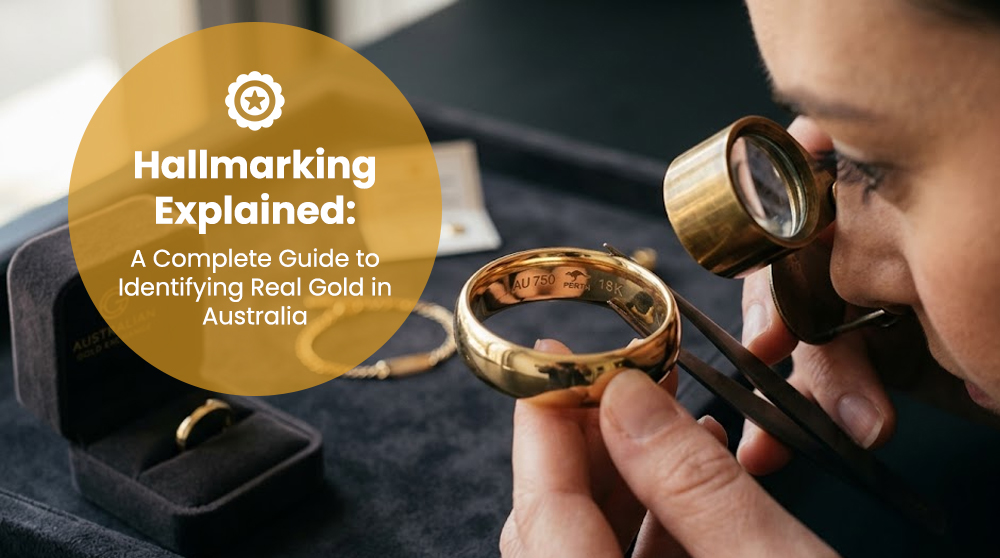
Most people, when they pick up a piece of gold jewellery, will turn it over and look for a tiny stamp on the back. They can see there’s something there, like a number, a letter, or a small symbol. These stamps are called hallmarks, and they’re one of the most useful pieces of information on your precious metal.
This guide is going to walk you through everything you need to learn about hallmarking. What hallmarks are, what the numbers mean, why they matter, what their limitations are, and how to make sure you’re getting an accurate reading on any gold you’re buying or selling. By the end, nothing about this topic will feel confusing anymore. Read on.
What Is Gold Hallmarking
Gold hallmarking is essentially a stamp or marking placed on a gold item to indicate its purity. It tells you how much of that item is actually made of gold.
- A 375 marking indicates 9K gold (37.5% pure).
- A 750 mark indicates 18K gold (75% pure).
- A 999 mark indicates 24K gold (pure).
Hallmarks on gold act as a quick reference point for both buyers and sellers before performing the purity test. Nonetheless, trusted gold dealers in Brisbane will always assess the purity of your gold using an XRF (X-ray fluorescence) to ascertain its value after reading the hallmark of your gold.
Why Hallmarking Is Important
If you’re buying a piece of gold jewellery, you want to know you’re getting what you’re paying for. A hallmark gives you a clear indication of how much gold your item contains, which builds trust between buyers and sellers and helps prevent people from being misled.
*Please note that hallmarks are a useful indicator of gold purity, but they should not be relied on alone. Stamps can sometimes be fake, altered, or added onto non-gold items, which is why professional testing is always recommended.
A gold buyer uses the purity of your gold, along with the weight and the current market price, to calculate what it’s worth. When your piece is clearly stamped 18K, 750, or any other markings, it can be assessed quickly and confidently. But if a piece bears no stamp or mark, it takes longer to verify and may require additional testing before a fair offer can be made.
What Do the Numbers Stamped on Gold Mean
Have you seen small numbers stamped on gold jewellery? They represent the percentage of pure gold in the item and are actually quite simple to understand.
Common Gold Purity Markings in Australia
In Australia, gold jewellery is most commonly stamped with either the karat marking (like 9K, 14K or 18K) or the fineness stamp (like 375, 585 or 750). Both systems give you the same information; they’re just two different ways of writing it. Some older Australian jewellery may also carry the word “gold” or abbreviations like “GF” (gold-filled) or “GP” (gold-plated), which are important to distinguish because gold-filled and gold-plated items are not solid gold and are worth significantly less.
Because of this, understanding purity goes beyond just reading a marking and involves proper testing using advanced XRF testing methods.
At Cash Your Gold, a gold test is conducted in front of you, using XRF technology, with up-to-date gold rates explained before any final decision to sell your gold is made.
Hallmarked Gold vs Non-Hallmarked Gold
Here’s a table showcasing key differences between hallmarked and non-hallmarked gold.
| Aspect | Hallmarked Gold | Non-Hallmarked Gold |
| Stamp Presence | Has a visible stamp like 750 or 18K | No visible stamp or an old heirloom piece |
| Ease of Identification | Easy to identify purity at first glance | Requires testing to confirm purity |
| Valuation Process | Faster and more straightforward | Slightly slower as testing is needed |
| Reliability | Good starting point, but still needs verification | Still potentially genuine, but needs testing. |
| Common Scenario | Modern jewellery and standard pieces | Older or heavily worn jewellery |
| Key Insight | The stamp helps, but it isn’t final proof | No stamp doesn’t mean fake or worthless |
Is Hallmarked Gold Always Genuine?
A hallmark is a very useful indicator of the purity of your precious metal, but it’s not a guarantee. Gold stamps can be faked. In some parts of the world, counterfeit gold items are manufactured with fake stamps that mimic legitimate hallmarks. A gold item might be stamped 750 and look like 18K gold, but if it was made dishonestly (like filling with copper and just plating with gold), the stamp could be misleading.
How to Identify Real Gold in Australia
If you’re trying to find out whether something is real gold before you take it to a buyer, here are a few practical things you can do at home. Read on.
- Look for a hallmark or stamp: Use good lighting and a magnifying glass if you have one, and check the inside of rings, the clasp of necklaces and bracelets, and the back of pendants and earrings. You will find a legitimate karat or fineness stamp if the precious metal you own is real gold. Also note that there can also be heirloom pieces which may not have hallmarks, but can be tested at a dealer/jeweller.
- Observe the colour: Real gold has a consistent, warm yellow colour throughout. If the colour is patchy, or if you can see a different colour underneath through wear or damage, that’s a sign the gold may be plated rather than solid.
- Feel the weight: Gold is a dense, heavy metal. A genuine gold item tends to feel heavier than it looks. If something feels very light for its size, that can be a hint to check for purity using an XRF machine to assess it accurately!
- Take it to a professional: A professional test is the only reliable method. A reputable buyer like Cash Your Gold will test your precious metal in front of you, explain the result, and confirm the exact details of your item without any vague or generic explanations.
Australian Hallmarking vs Other Countries
In some countries, hallmarking is mandatory and tightly regulated. In India, the Bureau of Indian Standards (BIS) runs a compulsory hallmarking scheme where certified gold items carry a standardised BIS stamp, a purity mark, and a unique centre code.
Australia doesn’t have a mandatory hallmarking scheme. But, quality standards like the Australian Standard AS 1812 set out the requirements for how gold articles should be described and stamped. But hallmarking itself is not compulsory in the same centralised way it is in the UK or India.
How Cash Your Gold Helps You Verify Gold
At Cash Your Gold, we understand that walking in with a piece of gold and not being entirely sure what you have can feel confusing. Thus, we use XRF technology to identify the exact purity of your gold right there in front of you. You watch the test, you see the result, and we explain what it means in simple language.
If your piece is stamped 750 and the test confirms it’s 18K gold, we’ll show you exactly how that result translates into a value using the current live gold market rate. Our friendly staff will never pressure you to sell your precious metals until you are happy and satisfied with our offer.
Speak with our experts today!
- 📞 Call: 1300 678 175, or
Visit
1. Chermside (North Brisbane)
- Address: Chermside – Suite 5, 832 Gympie Rd, Chermside, Qld 4032, Australia
- Phone: 07 49 390 234
- Email: [email protected]
- Opening Hours: Monday to Friday: 9 am to 5 pm | Saturday: 10 am to 4 pm | Sunday: Closed
- Details: Located opposite Westfield Chermside, with parking available behind the building and easy access via Hamilton Road.
2. Sunnybank (South Brisbane)
- Address: Sunnybank – Level 1, Suite 6/409 Mains Rd, Macgregor, Qld 4109, Australia
- Phone: 07 2142 6862
- Email: [email protected]
- Opening Hours: Monday to Friday: 9 am to 5 pm | Saturday: 10 am to 4 pm | Sunday: Closed
- Details: Conveniently located in the heart of Sunnybank, easily accessible for residents.
3. Brownsplains (South-West Brisbane)
- Address: Browns Plains – Unit 3/3376, Mount Lindesay Hwy, Regents Park, Qld 4118, Australia
- Phone: 07 2142 6482
- Email: [email protected]
- Opening Hours: Monday to Friday: 9 am to 5 pm | Saturday: 10 am to 4 pm | Sunday: Closed
- Details: Situated along the Mount Lindesay Highway, this location serves the south-western suburbs of Brisbane.
Frequently Asked Questions (FAQs)
1. What is gold hallmarking, and why is it important?
Hallmarking is a stamp that shows the purity of gold. It helps you understand how much real gold is in an item and supports fair valuation.
2. How can I identify real gold in Australia?
You can check for stamps and basic characteristics, but the most reliable way is professional testing to confirm purity.
3. What do the numbers stamped on gold mean?
They represent gold purity. For example, 916 means 91.6% gold, while 750 means 75% gold.
4. Is Hallmark Gold always genuine?
Not always. Stamps can sometimes be misleading or fake, so testing is still important.
5. What are the common gold purity markings in Australia?
Common markings include 999 (24K), 916 (22K), 750 (18K), and 585 (14K), along with karat labels like 18K or 22K.
6. How is gold hallmarking different in Australia compared to other countries?
Australia does not have a single mandatory hallmarking system like some countries, so not all gold is stamped.
7. Can fake gold have a hallmark stamp?
Yes, fake items can carry stamps, which is why you shouldn’t rely on them alone.
8. How can I test gold at home to check if it is real?
Basic methods like magnet tests can help slightly, but they are not fully reliable. Professional testing is more accurate.
9. What is the difference between 18k, 22k, and 24k gold?
The difference is purity. 24K is pure gold, while 22K and 18K contain other metals mixed in.
10. Are Australian gold hallmarking standards regulated?
Yes, standards exist, but hallmarking is not always mandatory, so verification is still important.